Most people who visit your camp’s website won’t register for summer camp, book a retreat, or request more information during their first visit. That doesn’t mean they aren’t interested—it usually means they aren’t ready.
Whether someone is researching summer camps for next year, comparing retreat centers for their church, or evaluating outdoor education programs for their school, major decisions take time. People gather information, compare options, involve other decision-makers, and often leave before taking the next step.
Unfortunately, once they leave your website, many camps lose the opportunity to continue the conversation.
That’s where camp retargeting ads come in.
Retargeting helps your camp stay visible after someone leaves your website by showing relevant ads while they browse Facebook, Instagram, YouTube, Google, and thousands of other websites. Instead of relying on visitors to remember your camp weeks later, you continue building familiarity and trust until they’re ready to register or book.
For many camps, retargeting is one of the highest-return forms of digital advertising because it focuses your budget on people who have already demonstrated interest.
What Are Camp Retargeting Ads?
Camp retargeting ads are digital advertisements shown specifically to people who have already visited your camp’s website.
Using tracking technology such as the Meta Pixel or Google Tag, your website can anonymously identify previous visitors and place them into advertising audiences. Those visitors can then see relevant ads as they continue browsing online.
Rather than advertising to complete strangers, you’re reconnecting with people who have already explored your programs, viewed your facilities, or considered booking with your camp.
Because these audiences are already familiar with your organization, retargeting campaigns often generate more inquiries, registrations, and bookings than campaigns targeting completely new audiences.
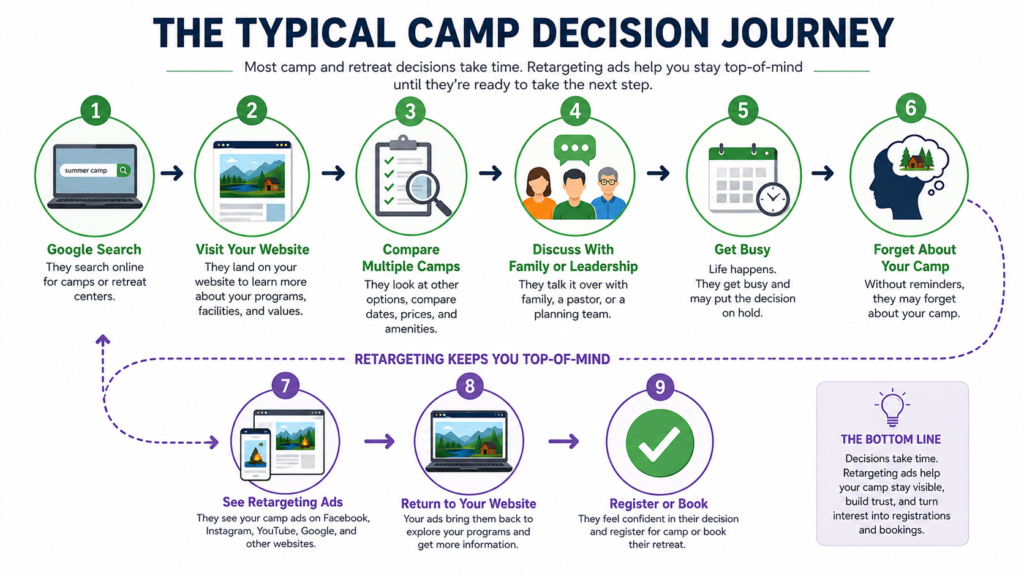
The Typical Camp Decision Journey
Most camp leaders assume visitors make a decision during their first visit.
In reality, the journey usually looks more like this:
Think about the last significant purchase you made.
Maybe it was a vacation, a vehicle, software for your business, or a home improvement project. Chances are you didn’t visit one website and make an immediate purchase. You probably researched multiple options, compared prices, read reviews, and came back several times before making your decision.
Camp registrations and retreat bookings follow the same pattern.
Parents compare programs.
Pastors evaluate several retreat venues.
School administrators research multiple outdoor education providers.
Corporate planners gather proposals from several locations.
In many cases, weeks—or even months—pass between the first website visit and the final booking.
Retargeting helps ensure your camp remains part of that decision process instead of being forgotten after the first visit.
Why Camp Retargeting Ads Work
Retargeting works because it aligns with how people actually make decisions.
Instead of assuming visitors are ready to commit immediately, it recognizes that trust develops over time.
For camps, that’s especially important because registrations and retreat bookings often involve:
- Multiple decision-makers
- Significant financial investment
- Schedule coordination
- Comparing several organizations
- Questions about safety, programming, facilities, or accommodations
Every additional interaction helps reinforce confidence.
Rather than asking visitors to remember your camp weeks later, retargeting gently reminds them that you’re still there when they’re ready to take the next step.
Some of the biggest benefits include:
Staying Top-of-Mind
Your camp continues appearing throughout the decision-making process instead of disappearing after a single website visit.
Reaching Higher-Intent Audiences
Previous website visitors have already shown interest, making them far more likely to engage than someone seeing your camp for the first time.
Improving the Return on Existing Marketing
Whether your traffic comes from SEO, the Google Ad Grant, paid search, directory listings, email campaigns, or social media, retargeting helps convert more of the visitors you’re already attracting.
Building Familiarity and Trust
People naturally become more comfortable with brands they recognize. Consistent exposure can reduce uncertainty and increase confidence when it’s time to choose a camp or retreat center.
When Should Camps Use Retargeting Ads?
One of the biggest misconceptions is that retargeting is only useful for summer camp registration.
In reality, almost every program your camp offers can benefit from staying visible after someone leaves your website.
Retargeting works well for:
- Summer camp registration
- Day camps
- Overnight camps
- Family camps
- Youth retreats
- Men’s retreats
- Women’s retreats
- Church retreats
- Marriage retreats
- Outdoor education programs
- School field trips
- Homeschool programs
- Corporate retreats
- Team-building events
- Volunteer recruitment
- Seasonal fundraising campaigns
- Open houses
- Hiring seasonal staff
If visitors regularly come to your website without taking action, retargeting is worth considering.
Matching Ads to the Visitor
One of the biggest advantages of camp retargeting ads is the ability to personalize your message based on what someone was interested in.
Someone researching summer camp shouldn’t necessarily see ads about corporate retreats.
Likewise, someone comparing retreat facilities probably isn’t looking for outdoor education programs.
The more closely your advertising matches the visitor’s interests, the more relevant—and effective—it becomes.
| Visitor Viewed | Good Retargeting Message |
|---|---|
| Summer Camp page | Registration deadlines, camper stories, activities |
| Retreat Center page | Facility tours, testimonials, available dates |
| Outdoor Education page | School success stories and program highlights |
| Pricing page | What’s included, FAQs, value of your programs |
| Contact page | Schedule a tour or ask questions |
| Registration page (not completed) | Complete your registration before spots fill |
Rather than sending every visitor the same generic advertisement, tailor your message to where they are in the decision process.
Where Can Camp Retargeting Ads Appear?
Retargeting isn’t limited to one advertising platform.
In fact, most successful campaigns use multiple platforms together so visitors continue seeing your camp wherever they spend time online.
Facebook remains one of the strongest retargeting platforms because many parents, grandparents, church leaders, alumni, and community members use it regularly.
Effective Facebook ads often feature:
- Camper photos
- Family testimonials
- Registration reminders
- Upcoming events
- Seasonal promotions
- Camp stories
Instagram works especially well for visually showcasing the camp experience.
Short videos, drone footage, activity photos, worship moments, and behind-the-scenes content help prospective campers imagine themselves at your camp.
Google Display Network
The Google Display Network allows your ads to appear across millions of websites and mobile apps.
Someone may leave your website, read the local news later that evening, and see your camp again while browsing.
Because the audience has already visited your website, these ads often feel like a helpful reminder rather than an interruption.
YouTube
Video is one of the best ways to communicate the atmosphere of your camp.
Short videos can showcase:
- Worship sessions
- Zip lines
- Waterfront activities
- Campfires
- Dining halls
- Retreat facilities
- Guest experiences
For organizations considering a retreat venue or parents evaluating summer camps, seeing your environment often creates a stronger emotional connection than static images alone.
While not appropriate for every organization, LinkedIn can be an effective platform for camps marketing:
- Corporate retreats
- Leadership retreats
- Executive team-building events
- Professional development programs
Choosing the Right Platform
Different advertising platforms serve different purposes.
| Platform | Best For | Primary Strength |
|---|---|---|
| Parents, alumni, churches | Broad reach and community engagement | |
| Families and younger audiences | Strong visual storytelling | |
| Google Display | All visitor types | Massive online reach |
| YouTube | Summer camp and retreats | Immersive video experiences |
| Corporate retreats | Professional audiences |
Many camps find the best results by combining Facebook or Instagram with Google Display, allowing them to stay visible across both social media and the broader web.
How Much Should Camps Budget for Retargeting Ads?
One of the biggest advantages of camp retargeting ads is that they don’t require enormous advertising budgets.
Unlike traditional awareness campaigns that introduce your camp to completely new audiences, retargeting focuses only on people who have already visited your website. That means you’re advertising to a much smaller—and much more qualified—group of people.
For that reason, retargeting campaigns are often among the most cost-effective digital advertising strategies available.
While every camp is different, the following ranges provide a reasonable starting point.
| Camp Size | Suggested Monthly Budget |
|---|---|
| Smaller camps | $100–300 |
| Growing camps | $300–750 |
| Larger organizations | $750+ |
These budgets assume your website is already generating consistent traffic through sources such as:
- Organic search (SEO)
- The Google Ad Grant
- Google Search Ads
- Social media
- Email marketing
- Directory listings
- Word-of-mouth referrals
If only a handful of people visit your website each month, your money is usually better spent increasing website traffic first. Retargeting becomes significantly more effective once a healthy flow of visitors is already coming to your site.
What We’ve Learned Working With Camps
One pattern we’ve seen repeatedly is that camps often work hard to attract visitors but have no strategy for reconnecting with them after they leave.
They invest in:
- Search engine optimization
- The Google Ad Grant
- Google Search Ads
- Directory listings
- Email marketing
- Social media
- Print materials
- Conferences and networking
All of those efforts drive people to the website.
Then…
Nothing.
A visitor leaves the site and disappears.
Retargeting fills that gap.
Rather than treating every website visit as a one-time opportunity, it recognizes that people often need multiple interactions before making an important decision.
We’ve found that retargeting is especially effective when combined with:
- Strong landing pages
- Clear calls to action
- Helpful follow-up emails
- High-quality photography
- Authentic testimonials
- Simple inquiry forms
Retargeting isn’t a replacement for these fundamentals. It’s the bridge that helps more visitors benefit from them.
Best Practices for Camp Retargeting Ads
Not every retargeting campaign performs equally well.
The most successful campaigns are intentional about audience selection, messaging, and timing.
Match the Ad to the Visitor
Someone researching your retreat facilities shouldn’t immediately see ads promoting summer camp.
Likewise, a parent comparing summer camp programs probably isn’t interested in your corporate retreat offerings.
Whenever possible, create separate audiences based on the pages people visited and tailor the ads accordingly.
Rotate Your Ads
Seeing the exact same advertisement twenty times quickly becomes background noise.
Instead, rotate different creative, including:
- Camper stories
- Guest testimonials
- Facility photography
- Staff introductions
- Program highlights
- Drone videos
- Registration reminders
- Seasonal promotions
Refreshing your ads regularly helps prevent ad fatigue while giving prospective guests multiple reasons to come back.
Focus on Building Trust
Most people don’t need more advertising.
They need more confidence.
Your ads should answer questions like:
- Is this camp trustworthy?
- Will my child be safe?
- Will this retreat meet our group’s needs?
- What makes this camp different?
- Can I picture myself here?
Instead of leading with discounts or urgency, many camps see better results by highlighting:
- Guest testimonials
- Parent reviews
- Accreditation
- Years of experience
- Safety practices
- Beautiful photography
- Real camp experiences
Give People a Simple Next Step
Every advertisement should answer one question:
What should someone do next?
Examples include:
- Register today
- Schedule a tour
- Request information
- View available retreat dates
- Download our camp guide
- Learn more
Avoid asking people to make multiple decisions at once.
One clear call to action almost always performs better.
Common Mistakes to Avoid
Even well-designed campaigns can underperform if a few common mistakes aren’t addressed.
Showing Everyone the Same Ad
Generic ads produce generic results.
Personalized ads consistently outperform one-size-fits-all campaigns.
Running Ads Too Long
Just because someone visited your website six months ago doesn’t mean they’re still actively planning a retreat.
Choose audience durations that reflect your typical buying cycle.
For many camps, 30–90 days is a reasonable starting point, though retreat bookings may justify longer windows.
Ignoring Mobile Users
Most visitors will first encounter your website—and your ads—on a mobile device.
Make sure:
- Landing pages load quickly.
- Forms are easy to complete.
- Buttons are easy to tap.
- Images display well on smaller screens.
A great retargeting campaign can’t overcome a frustrating mobile experience.
Forgetting to Measure Results
Clicks are helpful.
Bookings are better.
Track metrics that actually matter, including:
- Registrations
- Inquiry forms
- Retreat requests
- Phone calls
- Tour requests
- Cost per inquiry
- Cost per registration
- Return on ad spend
Those numbers tell you whether your campaigns are contributing to your organization’s goals.
When Retargeting Doesn’t Make Sense (Yet)
Retargeting is powerful—but it isn’t always the first priority.
If your website receives very little traffic, there’s simply not much audience to retarget.
Likewise, if visitors arrive but quickly leave because your website is confusing or your messaging isn’t clear, retargeting won’t solve those underlying problems.
Consider addressing these areas first if:
- Your website attracts very little traffic.
- Your landing pages have very low conversion rates.
- Your value proposition isn’t clear.
- Your inquiry process is confusing.
- You’re not tracking conversions.
- Your website needs significant usability improvements.
Once those fundamentals are in place, retargeting becomes much more effective because you’re bringing visitors back to a stronger experience.
Camp Retargeting Checklist
Before launching your first campaign, make sure you’ve completed the following steps.
Website Tracking
- Install the Meta Pixel.
- Install the Google Tag.
- Configure conversion tracking.
- Verify events are firing correctly.
Build Your Audiences
Create audiences for visitors who viewed:
- Summer camp pages
- Retreat pages
- Outdoor education pages
- Pricing pages
- Contact pages
- Registration pages
Exclude people who have already completed the desired action whenever appropriate.
Create Your Ads
Develop multiple versions featuring:
- Beautiful photography
- Short videos
- Testimonials
- Registration reminders
- Program highlights
- Seasonal messaging
Avoid relying on just one advertisement.
Launch and Optimize
After launching:
- Monitor conversions weekly.
- Refresh creative every few months.
- Test different headlines.
- Test different images.
- Experiment with audience durations.
- Compare different calls to action.
Small improvements over time often produce significant gains.
What’s the Difference Between Retargeting and Cold Advertising?
Understanding this distinction helps determine where each strategy fits.
| Retargeting Ads | Cold Advertising |
|---|---|
| Audience has already visited your website | Audience has never interacted with your camp |
| Higher intent | Lower initial intent |
| Reinforces familiarity | Creates first awareness |
| Usually lower cost per inquiry | Usually higher cost per inquiry |
| Builds on existing marketing | Introduces your organization to new audiences |
Both strategies have value.
For many camps, cold advertising introduces new people to the organization, while retargeting helps convert interested visitors into registrations and bookings.
Download the Camp Retargeting Planning Worksheet
Launching successful camp retargeting ads starts with a plan.
Before building audiences or designing ads, it’s helpful to think through who you’re trying to reach, what message they’ll see, and what action you want them to take.
To help you organize your campaign, we’ve created a free Camp Retargeting Planning Worksheet.
The worksheet helps you define:
- Your campaign objectives
- Audience segments
- Advertising platforms
- Messaging ideas
- Creative assets
- Calls to action
- Budget
- Success metrics
Whether you’re launching your first retargeting campaign or refining an existing one, this worksheet provides a practical framework for building campaigns that are more focused and more effective.
👉 Download the Camp Retargeting Planning Worksheet
Frequently Asked Questions About Camp Retargeting Ads
What are camp retargeting ads?
Camp retargeting ads are digital advertisements shown to people who have already visited your camp’s website. Using tools like the Meta Pixel or Google Tag, previous visitors can be shown relevant ads across platforms such as Facebook, Instagram, YouTube, and the Google Display Network, helping your camp stay visible while they continue researching and making decisions.
What’s the difference between retargeting and remarketing?
The terms are often used interchangeably, but they’re not always identical.
Retargeting typically refers to paid digital ads shown to previous website visitors.
Remarketing can also include reconnecting with previous visitors through channels such as email marketing.
For most camp marketing discussions, you’ll hear the two terms used to describe the same general strategy of reconnecting with people who have already shown interest.
How much do camp retargeting ads cost?
One of the advantages of retargeting is that you’re advertising to a relatively small audience instead of the general public.
Many smaller camps can begin with budgets between $100 and $300 per month, while larger organizations often invest more depending on their website traffic and enrollment goals.
The appropriate budget depends less on the size of your organization and more on how many people visit your website each month.
Which advertising platform is best for camp retargeting ads?
There isn’t a single best platform for every camp.
- Facebook and Instagram are excellent for reaching parents, alumni, churches, and community members.
- Google Display keeps your camp visible while visitors browse millions of websites and apps.
- YouTube works well for showcasing your facilities and camp experience through video.
- LinkedIn can be effective for camps promoting corporate retreats or leadership events.
Many organizations see the strongest results by combining multiple platforms.
Are retargeting ads worth it for smaller camps?
Yes—provided your website receives enough traffic.
Retargeting campaigns work best when visitors are already finding your website through search engines, referrals, email marketing, directory listings, or other advertising efforts.
If only a handful of people visit your website each month, your first priority should usually be increasing website traffic. Once traffic becomes consistent, retargeting can significantly improve the return on those marketing efforts.
Can nonprofit camps run retargeting ads?
Absolutely.
Being a nonprofit doesn’t limit your ability to run retargeting campaigns.
Many Christian camps, retreat centers, conference centers, outdoor education organizations, and other nonprofit camps use retargeting to stay connected with prospective campers, retreat planners, donors, volunteers, and event organizers.
Can camps use the Google Ad Grant with retargeting?
This is one of the most common questions we receive.
The Google Ad Grant supports text ads that appear in Google Search results. It does not support display retargeting campaigns.
However, the two strategies complement each other extremely well.
Many camps use the Google Ad Grant to bring new visitors to their website through search while using paid retargeting campaigns on Facebook, Instagram, Google Display, or YouTube to reconnect with those visitors after they leave.
Together, they create a more complete marketing system.
How long should a camp run retargeting ads?
Most organizations run retargeting campaigns continuously throughout their primary marketing seasons.
Individual audience durations are often set between 30 and 90 days, depending on the length of the decision-making process.
Summer camp registrations may have shorter consideration periods, while church retreats, conferences, or school programs often require longer planning cycles.
Continue Learning
Retargeting works best as part of a broader marketing strategy.
If you’re looking to attract more visitors and convert more of them into registrations and retreat bookings, these resources are a good next step:
- How to Get $10,000 Per Month in Free Google Advertising (Google Ad Grant guide)
- How Directory Listings Help Camps Get Found Online
- Why Every Camp Needs a Google Business Profile
- How Fast Follow-Up Wins More Retreat Bookings
- Creating Landing Pages That Convert More Camp Visitors
- Camp SEO: Helping Families and Retreat Planners Find Your Camp
- Building a Camp Website That Turns Visitors Into Guests
Together, these strategies help create a marketing system that not only attracts more visitors but also converts more of them into campers, retreat guests, and long-term supporters.
Turn More Website Visitors Into Registrations and Retreat Bookings
Every marketing effort your camp invests in—whether it’s search engine optimization, the Google Ad Grant, social media, directory listings, email marketing, or word-of-mouth referrals—has one goal: bringing people to your website.
But attracting visitors is only half the challenge.
Most people won’t make a decision during their first visit.
That’s why camp retargeting ads are such an important part of a complete marketing strategy. They help you stay visible during the weeks—or even months—it often takes families, pastors, teachers, and retreat planners to make a decision.
When combined with a strong website, clear messaging, and an effective follow-up process, retargeting can help you get more value from the traffic you’re already earning.
If you’d like help determining whether retargeting makes sense for your camp—or if you want guidance building a marketing system that attracts more visitors and converts more of them into registrations and bookings—we’d love to talk.
👉 Book a Discovery Call and we’ll review your current marketing, identify opportunities for improvement, and discuss practical strategies for helping your camp grow.